MVC Components Breakdown
Designed using the Model-View-Controller (MVC) pattern to enforce a clear separation between data handling, user interface, and control logic. While MVC offered modularity and maintainability for this implementation, I understand that at scale — as in Amazon’s systems — microservices and event-driven architectures offer better scalability, fault isolation, and service independence. I'm currently deepening my understanding of distributed design by exploring containerization (Docker), orchestration (Kubernetes), and AWS-based service patterns to architect systems with production-level scalability.
System Flow Diagram
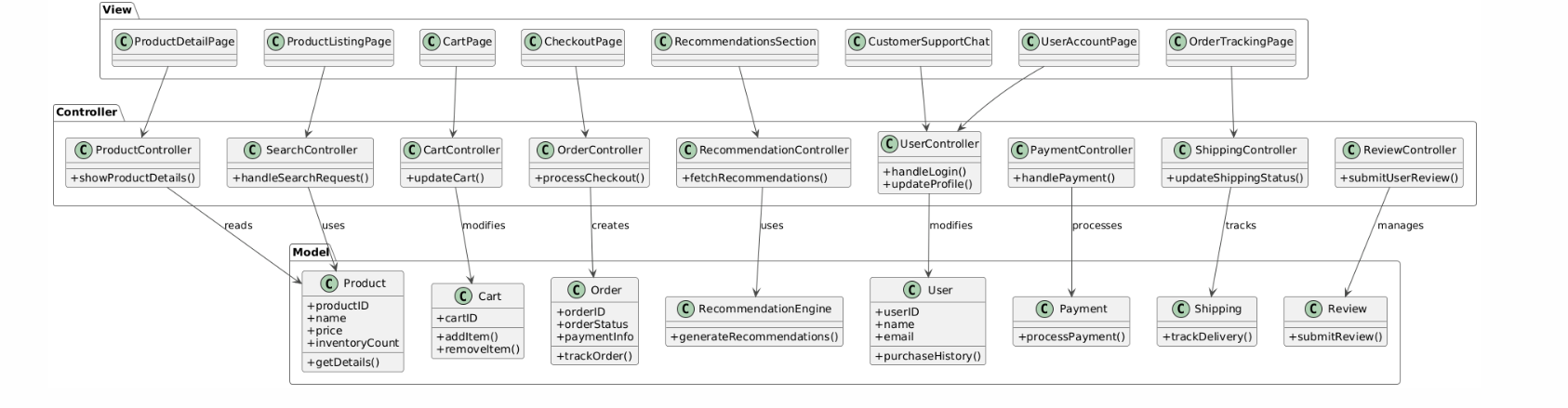
Model (Data + Business Logic)
- User: Stores user information, preferences, purchase history, payment methods.
- Product Model: Product details, pricing, stock availability.
- Order Model: Orders placed by users, order status, payment info.
- Cart Model: Items selected by the user for purchase.
- Review Model: Customer reviews and ratings.
- Inventory Model: Stock management, warehouse info.
- Recommendation Model: User preferences, purchase patterns. Responsibilities:
- Interact with the database.
- Enforce business rules (e.g., apply discounts, validate payment).
- Communicate with external services (payment gateways, logistics APIs).
View Layer
The View layer displays data to the user. For Amazon, this includes:
- Product Listing Page: Displays products, search results, filters.
- Product Details Page: Detailed view of a product.
- Cart Page: Displays items in the cart.
- Checkout Page: Payment forms, order summary.
- Order Confirmation Page: Displays order status.
- User Profile Page: User info and purchase history.
- Review Page: Form for submitting product reviews.
- Render data to users.
- Collect user inputs (clicks, form submissions).
- Provide responsive, dynamic UI for seamless shopping.
Controller Layer
Controllers receive user requests, interact with Models to process data, and select Views to render.
Some controllers for Amazon:
- Product Controller: Handles search, filtering, and displaying products.
- CartController: Manages adding/removing items from cart.
- OrderController: Handles order creation, payment, and tracking.
- UserController: Manages user registration, login, profile update.
- ReviewController: Handles submission and display of reviews.
- Receive and validate user inputs.
- Invoke appropriate Model methods.
- Choose which View to render based on outcomes.
- Handle errors and redirect flows as needed.
Overall Flow Example:
- User searches for a product on the Amazon homepage (View).
- The ProductController receives the search input (Controller).
- It calls the Product Model to get matching products (Model).
- The controller sends this data back to the View for rendering the product list.
- User adds a product to their cart — CartController updates the Cart Model.
- The Cart View updates to show current cart contents.